What Is Mullein? An Honest Look at a Soft, Old-World Herb
Share This Article
Mullein is one of the more distinctive herbs we work with — soft to the touch, bold in flavour, and steeped in centuries of folk tradition. This profile keeps to what we can speak to honestly: what mullein is, how it looks, smells and tastes, how we prepare it, and what the traditional record and modern research do and do not tell us.
Important note. This article is for general education only. It is not medical advice, and Keha products are not intended to diagnose, treat, cure or prevent any condition — including any respiratory or lung condition. We make no health claims for mullein. If you have a respiratory concern of any kind (for example asthma, COPD, bronchitis or a persistent cough), please speak with a qualified healthcare professional rather than relying on any herbal product. This is especially important if you are pregnant, breastfeeding, or taking medication.
Meeting the leaf
The first thing anyone notices about dried mullein is the texture. It is remarkably fluffy — soft, almost woolly leaves quite unlike the crisp, brittle herbs you might expect in a tea tin. Picking up a handful is a genuinely pleasant, tactile thing.
The flavour is a different story, and Stephen is characteristically frank about it: on its own, mullein tastes smoky and musky. It is a bold, earthy profile that some people love and others find a lot to take neat.
From Stephen's bench: preparation and preference
This is founder experience, kept separate from tradition and evidence below.
Straight mullein is not one of Stephen's preferred herbs to drink alone — that smoky-musky character is simply a lot on its own. He much prefers it in company, balanced by brighter, sweeter, more aromatic herbs: fennel, eucalyptus, spearmint and licorice all sit well alongside it and round off its edges.
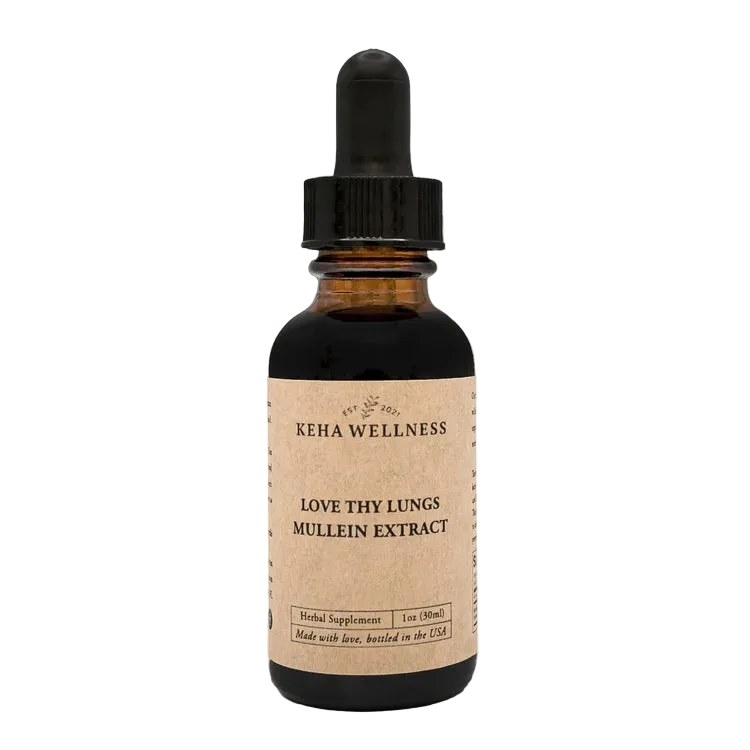
He does occasionally prepare mullein as an infusion, and it is a striking thing to watch. A finished mullein infusion can turn very dark — almost black in the cup. Our mullein tincture is similarly deep and dark. It is one of the more visually dramatic preparations in the apothecary, and worth seeing at least once.
The tradition — and the limits of the evidence
Mullein (Verbascum thapsus and related species) has a long place in European and North American folk herbalism, and its soft leaves and flowers have been used traditionally for a very long time. The European Medicines Agency lists mullein flower as a traditional herbal preparation — a classification that, by the EMA's own explanation, rests on long-standing customary use rather than on proof from clinical trials, and which the EMA pairs with a clear acknowledgement that robust clinical studies are lacking.
We want to be careful and clear here: traditional use is a record of how people have used a plant over time. It is not the same as demonstrated effectiveness, and it is not a claim from us. Reference bodies such as NCCIH and Memorial Sloan Kettering's About Herbs database likewise note that modern human evidence for mullein is limited. So we offer mullein for what it honestly is — a characterful, historically valued botanical with a wonderful texture and a bold flavour — and we make no claims about what it does in the body.
How we like to use it
Because of that intense flavour, our own preference is mullein blended rather than solo — paired with fennel, eucalyptus, spearmint or licorice to bring balance and lift. If you do try it as a single infusion, do not be alarmed by how dark it goes; that deep colour is simply part of its nature.
Explore the range
Browse our herbal tea collection, see our tinctures, or read more herb stories in the apothecary journal.
Sources
- European Medicines Agency (EMA), Verbasci flos (mullein flower) — herbal medicinal product — ema.europa.eu
- National Center for Complementary and Integrative Health (NCCIH), Herbs at a Glance — nccih.nih.gov
- Memorial Sloan Kettering Cancer Center, About Herbs, Botanicals & Other Products — mskcc.org