Herbal Tea for Bloating? A Practical Guide to Digestive Herbs, Brewing & What to Expect
Share This Article
If you've searched “herbal tea for bloating,” you've probably found a dozen lists naming the same handful of herbs. This isn't that. It's a plain walk through the herbs people actually reach for when they feel puffy or heavy after a meal, what they're like to drink, how to brew them properly, and — just as important — when a cup of tea isn't the right answer and it's worth seeing a doctor.
Straight talk first: Herbal tea can be part of an everyday food and beverage routine, but it isn't a substitute for medical care. Nothing here is meant to diagnose, treat, cure, or prevent bloating or any digestive condition. A warm, caffeine-free cup is a pleasant ritual, not a remedy — and if bloating keeps coming back, that's a conversation for your doctor (more on the warning signs below).
First, what people usually mean by “bloating”
Bloating is that feeling of fullness, pressure, or a visibly bigger belly, often after eating. It's extremely common and usually tied to ordinary things — a big meal, fizzy drinks, eating quickly, or certain foods. It's part of normal digestion for most people.1 It's also occasionally a sign of something that needs a doctor, which is why we've put the warning signs near the end rather than buried them.
The two herbal approaches people take
Most digestive teas fall into one of two camps, and it helps to know which you're looking at.
Aromatic “carminative” herbs — peppermint, spearmint, ginger, fennel. These are the bright, fragrant herbs most “tea for bloating” lists lead with. They're the herbs many people traditionally sip after a meal.
Demulcent herbs — slippery elm and marshmallow root. These are less famous but they're what a lot of herbalists reach for first. They're rich in mucilage, a soft, gel-like plant fibre, and they've long been used to make a smooth, soothing, coating sort of cup.
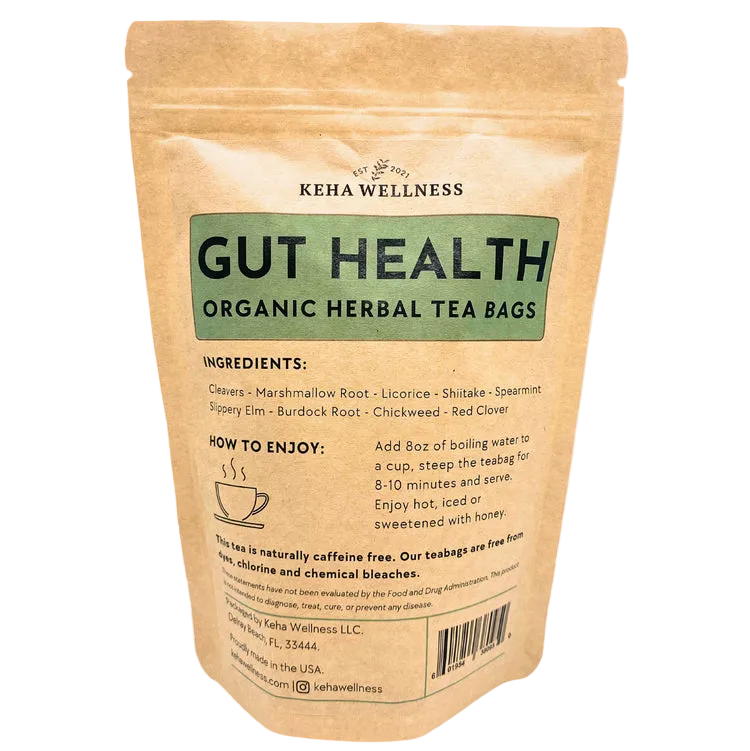
Our own Soothing Gut blend leans on the demulcent group and rounds it out with a little aromatic lift. It contains slippery elm, marshmallow root, burdock root, chickweed, cleavers, shiitake mushroom, spearmint, and licorice root.
The demulcent herbs, honestly
Slippery elm
Slippery elm (Ulmus rubra) is a North American tree, and it's usually the first digestive herb I think of. It's the inner bark that's used, and its main constituent is mucilage, which gives it a soft, slightly slippery quality in water — that's where the name comes from. Herbalists classify it as a demulcent.2
Being honest about the evidence: slippery elm has a long history of traditional use for the throat and digestive tract, but rigorous human research is limited. Memorial Sloan Kettering notes that mucilage gives it demulcent effects, and that a small study of a multi-herb formula containing slippery elm reported improved bowel habits — but that's a blend, not slippery elm alone, and human data for most uses are lacking.2 So we treat it as a traditional, soothing herb, not a treatment.
Marshmallow root
Marshmallow root (Althaea officinalis) is my close second — another mucilage-rich demulcent. The European Medicines Agency recognises marshmallow root as a traditional herbal medicinal product, used on the basis of long-standing use for irritation of the mouth and throat and for mild stomach and gut discomfort. Importantly, the EMA is clear that this rests on traditional use rather than firm clinical-trial evidence.3
A note on cold-brewing marshmallow. When I make marshmallow root on its own, I prefer a cold infusion — soaking it in cool water rather than pouring boiling water over it. That's my personal preference and a common traditional practice for mucilage-rich roots; I'm not claiming it's scientifically better, just that it's how I like to do it and how a lot of herbalists prepare it.
(Full single-herb guides for slippery elm and marshmallow root are on our Herbal Library roadmap.)
How I think about it across the counter
When someone comes into the shop asking about bloating, I don't reach straight for a tin of tea. I usually ask a few simple questions first: how long has it been going on, does it come and go or is it constant, and is there any actual pain? Those answers matter. Occasional, comes-and-goes puffiness after a big meal is one thing; persistent or painful symptoms are a reason to see a doctor rather than try to sort it out with tea. If it's the everyday kind, then we can talk about a soothing cup and how to brew it.
What Soothing Gut is actually like to drink
People always want to know what a tea tastes like before they buy it, so here's the honest description.
Straight out of the bag, the aroma is led by sweet spearmint — it's the first thing you notice. Brewed, the blend comes out naturally sweet and smooth, with a light golden-brown colour in the cup. It's genuinely easy to drink, which is a big part of why it's quietly become the people's favourite in our range.
How to brew it: steep for about 5–8 minutes. I enjoy it both hot and iced — although, being a Brit, I'll happily drink it hot on the hottest day of the year. Most customers tell me they reach for it after meals.
Getting a second cup out of it: our tea bags are a generous 4 grams, so there's often plenty of flavour left for a second brew. Each 4 g tea bag can often give you a strong second brew.
Common questions
What tea is “good” for bloating?
There's no single answer, and be wary of anything promising to “get rid of” bloating. People tend to reach for aromatic herbs like peppermint, spearmint, ginger, and fennel after meals, or for demulcent, mucilage-rich herbs like slippery elm and marshmallow. Our Soothing Gut blend combines both ideas. What matters most is that you enjoy the cup and it fits your routine.
When do people drink it?
Most often after meals. That's customer habit and personal preference — not a claim that it does anything specific to your digestion.
Can I reuse the tea bag?
Yes — our 4 g bags usually have enough flavour for a second brew, so give it a go before you bin it. (Brew your second cup the same day, and use your own judgment as you would with any food.)
What does it taste like?
Sweet spearmint on the nose, naturally sweet and smooth in the cup, light golden-brown. One of our easiest-drinking blends.
Hot or iced?
Both work well. Brew it a touch stronger if you're planning to pour it over ice.
When a cup of tea isn't the answer
This is the part most tea articles skip. Bloating and gas are usually harmless, but see a doctor if it won't go away, or if it comes with any of these, because they can point to something that needs proper attention:1
- blood in your stool
- a change in how often you go, or in the consistency of your stool
- unexplained weight loss
- ongoing constipation or diarrhea
- recurring nausea or vomiting
Seek prompt medical care for prolonged stomach pain or any chest pain.1 No tea is a substitute for that.
A couple of safety notes
Soothing Gut contains licorice root. Because this blend contains licorice root, people who are pregnant, have high blood pressure, take medications, or have an ongoing health condition should check with an appropriate healthcare professional before using it regularly. If digestive symptoms are persistent, worsening, painful, or otherwise concerning, get appropriate medical advice rather than continuing to self-manage them with herbal products.
If you'd like to try it
Our Soothing Gut blend comes as Soothing Gut Tea Bags and Soothing Gut Loose Leaf. If you'd rather work with the single herbs — to brew on their own or build your own blend — we carry Slippery Elm and Marshmallow Root, and you can browse the whole Digestive & Gut Health collection or our wider Loose Herbs & Apothecary.
New to brewing loose herbs? Our How to Brew the Perfect Cup of Herbal Tea guide covers the basics.
Educational content from the Keha Herbalist Notebook. Hand-blended in South Florida.
References
- Mayo Clinic, “Gas and gas pains — Symptoms & causes.” mayoclinic.org
- Memorial Sloan Kettering Cancer Center, “About Herbs: Slippery Elm” (Ulmus rubra). mskcc.org
- European Medicines Agency (HMPC), “Althaeae radix — herbal medicinal product” (Althaea officinalis). ema.europa.eu